


Building a Data Foundation for Analytics and AI
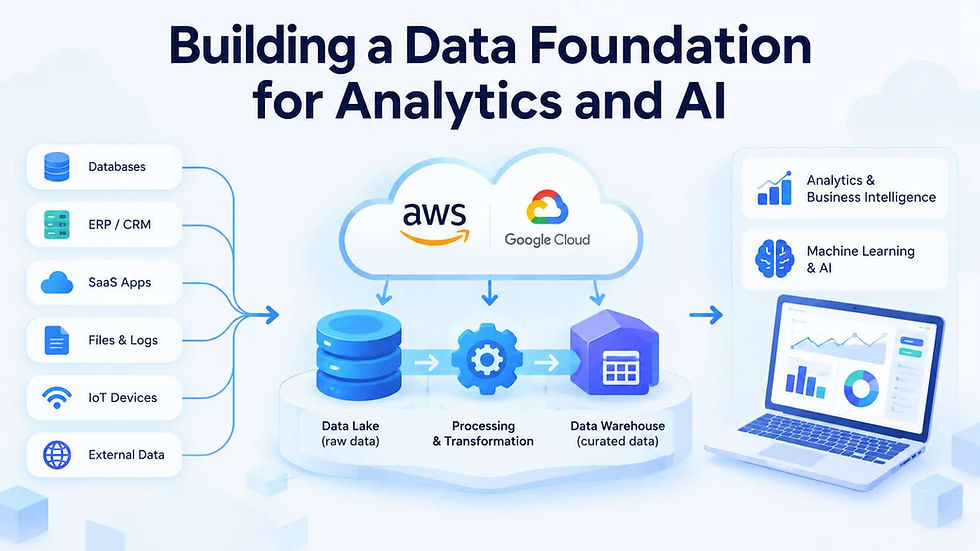
Companies increasingly rely on data to improve operations, understand customers, forecast demand, and automate business decisions. However, collecting more data does not automatically produce better insights. Information is often scattered across enterprise resource planning (ERP) systems, customer relationship management (CRM) platforms, SaaS applications, transactional databases, and external services. These sources may use different formats, follow inconsistent conventions, and update at different intervals.
Before organizations can benefit from analytics and artificial intelligence, they need a data environment that makes information accessible, consistent, secure, and suitable for further processing. Building this foundation requires more than selecting a cloud platform. It involves designing an architecture, integrating data sources, establishing reliable pipelines, and preparing datasets for analytical and machine learning workloads.
1. Start with Business Requirements and Data Sources
The first step is to understand what the organization wants to achieve with its data. Different objectives require different architectural decisions. A company building operational dashboards may prioritize timely reporting and consistent business metrics, while an organization developing predictive models may need historical datasets, detailed event records, and access to large volumes of unstructured information.
Teams should identify the business questions that the data environment must answer. Examples include forecasting inventory requirements, identifying customer churn, monitoring production performance, and detecting unusual financial transactions.
Next, organizations need an inventory of their existing data sources. This assessment should cover databases, business applications, APIs, spreadsheets, log files, IoT devices, and third-party data providers. For each source, teams should document the data format, update frequency, volume, ownership, access requirements, and known quality issues.
This discovery process often reveals that apparently similar information is stored differently across systems. Customer identifiers may not match, timestamps may use different time zones, and product categories may follow incompatible naming conventions. Identifying these inconsistencies early helps teams avoid building pipelines that simply transfer existing problems into a new environment.
Business priorities should guide implementation. Rather than migrating every available dataset immediately, companies can begin with a small number of high-value use cases and expand the platform as requirements become clearer.
2. Design a Scalable Cloud Data Architecture
A cloud-based data environment typically includes several interconnected layers: ingestion, storage, transformation, data serving, and consumption. Each layer has a distinct responsibility, allowing organizations to expand individual components without redesigning the entire platform.
Data ingestion connects source systems to the cloud environment. Depending on the source and business requirements, this may involve scheduled batch imports, event-driven processing, or continuous streaming. Batch ingestion is often sufficient for daily financial reports, whereas fraud detection or equipment monitoring may require near-real-time updates.
The storage layer provides a central location for raw and processed information. Cloud object storage is commonly used for large datasets because it can accommodate structured, semi-structured, and unstructured files. A data lake can preserve information in its original form, while a data warehouse provides structured datasets optimized for reporting and analytical queries. Many organizations combine these approaches in a lakehouse architecture or use a lake alongside a separate warehouse.
AWS and Google Cloud offer infrastructure for implementing these designs. Services such as Amazon S3, AWS Glue, and Amazon Redshift support storage, data integration, and analytical processing. Google Cloud provides corresponding capabilities through Cloud Storage, Dataflow, BigQuery, and related services.
The appropriate configuration depends on existing technology, data volume, latency requirements, operational expertise, and cost constraints. Organizations should evaluate the complete architecture rather than selecting individual services in isolation. Integration, monitoring, security, and ongoing maintenance can have a greater long-term impact than the choice of any single component.
3. Build Reliable Data Pipelines
Cloud infrastructure provides the foundation, but pipelines determine whether information moves through the environment consistently. They extract data from source systems, validate incoming records, apply transformations, and deliver usable datasets to storage or analytical services.
Effective engineering reliable data pipelines begins with predictable processing behavior. Pipelines should handle temporary connection failures, interrupted jobs, unexpected input formats, and changes in source schemas without silently producing incomplete results.
Several practices help achieve this reliability.
First, ingestion processes should be repeatable. If a scheduled job fails halfway through execution, the system should be able to resume or rerun it without creating duplicate records. Idempotent operations, checkpoints, and appropriate transaction boundaries help protect data consistency.
Second, validation should happen throughout the pipeline. Checks can identify missing values, invalid timestamps, unexpected numerical ranges, duplicate identifiers, and broken relationships between tables. When data fails validation, the pipeline should record the problem and apply an agreed policy, such as quarantine, controlled rejection, or escalation.
Third, teams need observability. Monitoring should cover execution status, processing duration, record counts, data freshness, error rates, and unexpected changes in volume. Alerts can notify engineers when a pipeline fails or when a critical dataset becomes outdated.
Automation also matters. Workflow orchestration tools can coordinate dependencies, manage retries, and schedule processing tasks. Infrastructure as code, version control, automated testing, and separate development and production environments make pipelines easier to maintain as the platform grows.
These practices are relevant across cloud providers. For example, data engineering on AWS may combine Amazon S3, AWS Glue, and orchestration services to process information from multiple business systems. The specific implementation will vary, but the underlying principles remain the same: controlled transformations, clear dependencies, measurable quality, and recoverable failures.
4. Establish Data Quality, Governance, and Security
A technically functional data platform is not necessarily a trustworthy one. Analytics and AI systems depend on the meaning, completeness, and consistency of the information they receive. Without governance, different departments may calculate the same business metric differently or rely on datasets that contain outdated records.
Organizations should establish shared definitions for important entities and measures. A documented definition of active customers, for instance, should specify the qualifying conditions and reporting period. Common definitions reduce discrepancies between dashboards and analytical models.
Data catalogs and metadata management tools help users discover available datasets, understand their structure, and identify responsible owners. Data lineage provides visibility into how information moves from source systems through transformations to reports and models. This makes it easier to investigate unexpected results and assess the impact of changes.
Security must be incorporated into the architecture from the beginning. Role-based access controls, least-privilege permissions, encryption, audit logging, and appropriate network restrictions help protect sensitive information. Personal and regulated data may require additional controls, retention policies, and restrictions on how datasets can be used for model development.
Governance should also define responsibilities. Data owners establish business rules, data engineers maintain processing systems, security teams oversee access policies, and analysts or data scientists communicate the requirements of downstream workloads.
These responsibilities become particularly important when data is shared across departments or external partners. A well-governed environment makes information easier to reuse without removing the controls needed to protect it.
5. Prepare Data for Analytics and AI
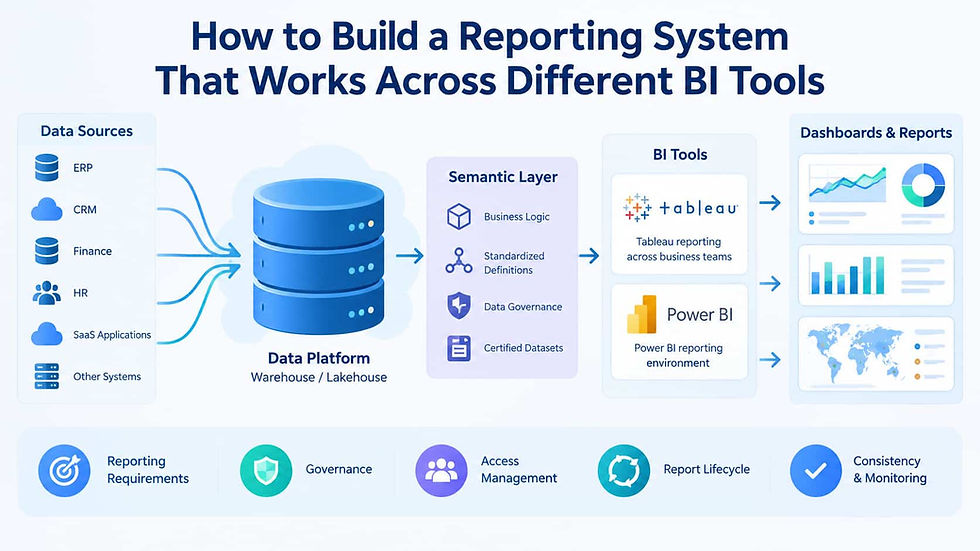
Once information is integrated and validated, the platform must support the people and applications that consume it. Business intelligence tools typically require curated tables, consistent dimensions, and clearly defined metrics. Data science teams may need additional flexibility to explore historical records, engineer features, and build reproducible training datasets.
The distinction matters because reporting and machine learning have different requirements. A dashboard might need daily aggregates, while a predictive model may require detailed event histories and carefully aligned timestamps. Designing for both workloads prevents the data environment from becoming optimized for a single use case.
Data engineers and data scientists should collaborate on dataset contracts, feature definitions, and validation criteria. Training data should be checked for leakage, inconsistent labels, and differences between historical and production inputs. Where appropriate, feature stores or reusable transformation libraries can help maintain consistent feature calculations across training and inference.
Cloud services can support these workloads without requiring every processing task to run on the same infrastructure. On Google Cloud, building data workloads on Google Cloud may involve preparing datasets in BigQuery, processing streaming information with Dataflow, and connecting curated data to machine learning tools. AWS offers comparable patterns for organizations using its analytics and machine learning ecosystem.
The architecture should also support experimentation and deployment. Versioned datasets, tracked transformations, reproducible environments, and monitored model inputs help teams move from exploratory analysis to production applications. When a model begins generating unreliable predictions, engineers should be able to determine whether the cause lies in the model itself or in changes to incoming data.
For organizations evaluating new AI initiatives, consulting for data science projects can help clarify data requirements, assess infrastructure readiness, and connect business objectives with practical implementation plans. The goal is to establish a realistic path from available information to measurable business outcomes rather than investing in sophisticated models before the underlying data is ready.
6. Control Costs and Evolve the Platform Gradually
Cloud platforms make it easier to expand storage and processing capacity, but flexibility does not eliminate cost management challenges. Repeatedly processing entire datasets, retaining unnecessary copies, running oversized compute resources, and executing inefficient analytical queries can increase expenses.
Teams should monitor costs by workload, department, and environment wherever practical. Incremental processing can reduce unnecessary computation, while partitioning and appropriate file formats can improve query performance. Lifecycle policies can move older data into lower-cost storage tiers when access requirements allow.
Architecture reviews should consider performance alongside cost. Not every dataset needs real-time processing, and not every analytical workload requires the same computing resources. Matching service configurations to actual requirements helps avoid paying for capabilities that provide little business value.
Implementation should proceed in stages. A practical first release might integrate a small number of important sources, establish core quality checks, and deliver a trusted dataset for one reporting or predictive use case. Subsequent releases can introduce additional sources, more sophisticated orchestration, expanded governance, and machine learning workflows.
This incremental approach provides opportunities to validate assumptions, demonstrate value, and adjust the architecture before complexity grows.
Conclusion
Building a data foundation for analytics and AI is an ongoing engineering and governance effort, not simply a cloud migration project. Organizations need to connect fragmented systems, design scalable storage and processing layers, maintain dependable pipelines, and establish clear standards for data quality, security, and ownership.
AWS and Google Cloud provide flexible infrastructure for these capabilities, but the value comes from how the components work together. When data engineering is aligned with business requirements and downstream analytical needs, companies can reduce inconsistencies, improve reporting, and develop AI applications on a more dependable foundation.
The most sustainable strategy is to begin with clearly defined business outcomes, deliver a manageable first implementation, and expand through measurable improvements. A well-designed data environment allows analytics and AI initiatives to evolve without repeatedly rebuilding the systems on which they depend.
Comments