


How to Decouple Legacy ERP Integrations Before a System Migration
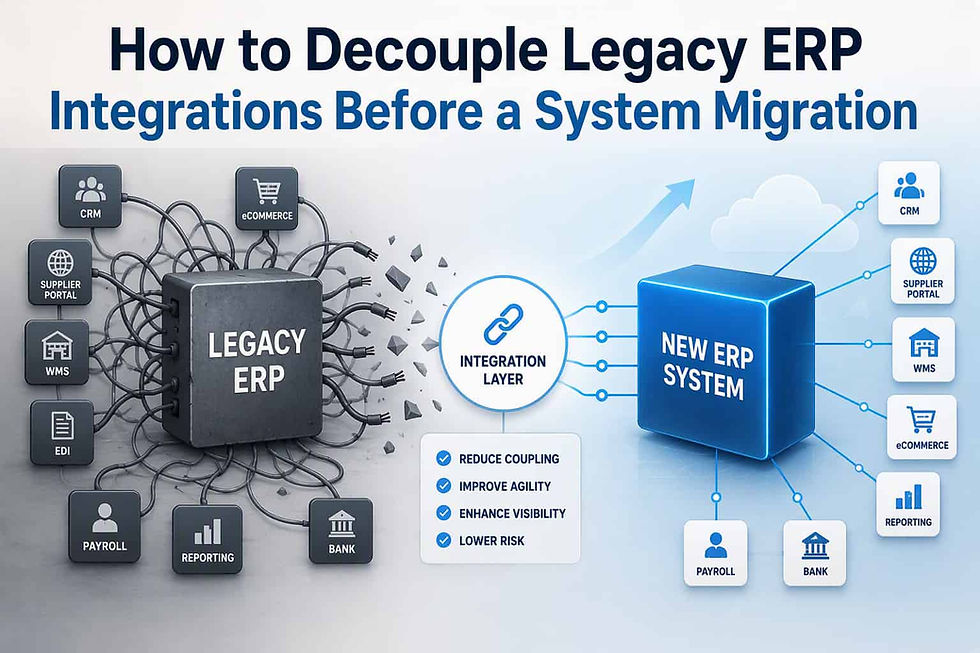
Legacy ERP systems rarely exist in isolation. Over years of business growth, they become connected to CRM platforms, warehouse management systems, e-commerce stores, payment providers, reporting tools, databases, custom applications, and countless small scripts. These connections may work reliably, but they can make a major ERP migration difficult to control.
When the ERP is tightly coupled to surrounding systems, even a relatively small change can have unexpected consequences. An interface may depend on a particular database field, a custom script may run after an overnight export, or an external application may rely on undocumented behavior inside the ERP.
Decoupling these integrations before migration can reduce this complexity. The objective is not to disconnect everything. It is to create clearer boundaries so that connected systems can continue operating while the ERP itself is modernized, replaced, or migrated.
Begin With an Integration Inventory
Before changing the architecture, organizations need to understand what is currently connected to the ERP.
The inventory should include formal APIs and middleware connections, but it should also cover less visible mechanisms. Direct database access, scheduled file transfers, batch jobs, custom scripts, stored procedures, spreadsheets, and manually triggered processes can all represent dependencies.
For every connection, document:
Source and destination systems
Data being exchanged
Direction of data flow
Integration method
Frequency of communication
Business process supported
Technical and business owners
Error-handling mechanism
Known dependencies
Consequences of failure
This creates a baseline for deciding which integrations can be separated first and which require more careful treatment.
Identify Tight Coupling
Not all integrations create the same level of migration risk. Some systems communicate through stable, well-defined APIs. Others may depend directly on the ERP's internal implementation.
Direct database access is one example of tight coupling. An external application that reads specific ERP tables may break when the database schema changes, even if the business capability itself remains available.
Custom scripts can create similar problems. A script may expect a particular file structure, field name, response format, or processing sequence. These assumptions may never have been formally documented.
Teams should therefore look beyond the connection itself and identify the assumptions behind it.
Separate Business Capabilities From ERP Implementation
A useful decoupling strategy is to define integrations around business capabilities rather than internal ERP structures.
For example, an e-commerce platform may need information about product availability. It should ideally consume a clearly defined inventory capability rather than depend on a particular ERP database table.
Similarly, a WMS may need order and shipment information without knowing how those records are stored internally by the ERP.
This distinction creates an abstraction layer between the business requirement and the existing implementation.
When the ERP changes, the surrounding applications can continue using the same business-oriented interface while the underlying implementation is replaced.
Introduce APIs Where They Provide a Clear Boundary
APIs can provide an important layer between legacy ERP functionality and connected applications.
Instead of allowing multiple systems to access the ERP database directly, organizations can expose selected capabilities through controlled interfaces. The API becomes responsible for defining data formats, authentication, validation, and error handling.
This does not mean every legacy function needs to become an API immediately. A more practical approach is to prioritize high-value capabilities that are used by several systems or that are likely to change during migration.
For example, customer information, product data, inventory availability, orders, and shipment status may be good candidates for controlled interfaces.
Replace Point-to-Point Connections Gradually
A legacy ERP environment may contain a large number of point-to-point integrations. While each connection may have been reasonable when created, their combined complexity can become difficult to manage.
Replacing every connection at once is rarely practical.
Instead, organizations can gradually introduce an integration layer. Selected applications communicate with the integration layer rather than directly with the ERP. The layer can handle routing, transformation, authentication, logging, and monitoring.
This creates a controlled transition path. Some connections can continue using the old ERP while others are redirected to new services.
Over time, the number of direct dependencies can decrease without requiring a single large migration event.
Protect Data Flows During the Transition
Decoupling does not eliminate the need for reliable data synchronization.
During a migration, the old ERP and new components may need to operate simultaneously. This can create challenges around duplicate records, conflicting updates, synchronization delays, and inconsistent states.
Organizations should define which system is authoritative for each important data domain.
For example, one platform may remain responsible for financial transactions while a new service becomes responsible for customer-facing product information. These boundaries should be explicit.
Teams should also determine whether data should move synchronously through APIs, asynchronously through messaging, or through controlled batch processes.
Use Events for Changes That Do Not Require Immediate Responses
Event-driven integration can be useful when connected systems do not need an immediate response from the ERP.
For example, when an order is created, an event can notify the warehouse, analytics platform, customer communication system, or other interested services.
This approach can reduce direct dependencies because consumers respond to business events rather than calling the ERP for every operation.
However, event-driven architecture introduces its own considerations, including message delivery, retries, ordering, idempotency, monitoring, and eventual consistency. It should therefore be introduced where it solves a specific integration problem rather than simply because it is a modern architectural pattern.
Create a Compatibility Layer
In some cases, existing applications cannot be changed immediately. A compatibility layer can help protect them while the ERP architecture evolves.
For example, if an existing application expects an old data format, an integration service can translate information from the new system into that format. The application continues operating while the underlying ERP dependency is gradually removed.
This approach is especially useful for business-critical applications that have long development cycles or limited modernization capacity.
It also allows teams to separate the timing of ERP migration from the timing of every connected application upgrade.
Remove Unnecessary Dependencies
Decoupling is also an opportunity to identify integrations that no longer serve a useful purpose.
Some legacy connections may support reports nobody uses. Others may have been created for temporary projects that ended years ago. Duplicate exports, abandoned scripts, and obsolete interfaces can continue consuming maintenance resources even when their business value is minimal.
Before migrating an integration, ask whether it is still required.
Removing unnecessary dependencies reduces both the technical scope of the migration and the number of components that must be tested afterward.
Test Connected Systems Independently
A decoupled architecture should make it easier to test integrations without requiring the entire ERP environment.
Contract testing can verify that an API continues to provide the expected interface. Integration tests can validate data transformations. Automated tests can check whether events are generated and consumed correctly.
Teams should also test failure scenarios. What happens when the ERP is unavailable? What happens when a message is delivered twice? What happens when a downstream application rejects a request?
Testing these conditions before migration can reveal weaknesses that may otherwise appear during the production transition.
Plan the Migration Around Dependencies
Once integration boundaries are clearer, migration sequencing becomes easier.
Systems with the fewest dependencies can often be separated earlier. Highly interconnected business capabilities may require more preparation.
Organizations should identify critical dependency chains and determine which components need to change first.
For example, an integration layer might be introduced before a new ERP is deployed. Existing applications can then connect through that layer while the underlying ERP changes behind it.
This approach creates a gradual path rather than requiring every connected system to switch at exactly the same time.
Maintain Observability Throughout the Transition
Decoupling creates new architectural boundaries, and those boundaries need visibility.
Monitoring should cover API requests, message queues, data synchronization, failures, processing times, and unusual traffic patterns. Logs should provide enough context to trace a transaction across systems.
This is particularly important during migration because teams need to distinguish between an ERP problem and an integration problem.
Good observability also provides evidence that previously hidden dependencies have actually been removed.
Treat Decoupling as a Business Continuity Strategy
The value of decoupling extends beyond cleaner architecture. It can reduce the number of systems that must change simultaneously.
When organizations focus on moving ERP dependencies without breaking connected systems, they can approach migration as a sequence of controlled changes rather than one large technical event.
The goal is to preserve essential business processes while individual components are modernized. This requires clear interfaces, defined ownership, controlled data flows, and careful testing, but it can significantly simplify the transition.
Conclusion
Decoupling legacy ERP integrations before migration is about creating separation between business capabilities and the technical implementation that currently supports them.
By inventorying integrations, identifying tight coupling, introducing controlled APIs, reducing point-to-point connections, defining data ownership, using compatibility layers, and removing obsolete dependencies, organizations can build a more manageable migration path.
The ERP does not need to be isolated overnight. Decoupling can happen incrementally, with each new boundary reducing the number of direct relationships that must be maintained.
A successful approach preserves critical business processes while gradually replacing fragile technical dependencies. The result is not simply an easier ERP migration, but an integration architecture that is easier to change and maintain afterward.
Comments