


Designing a Unified Data Layer Across ERP, WMS, TMS, and Carrier Systems
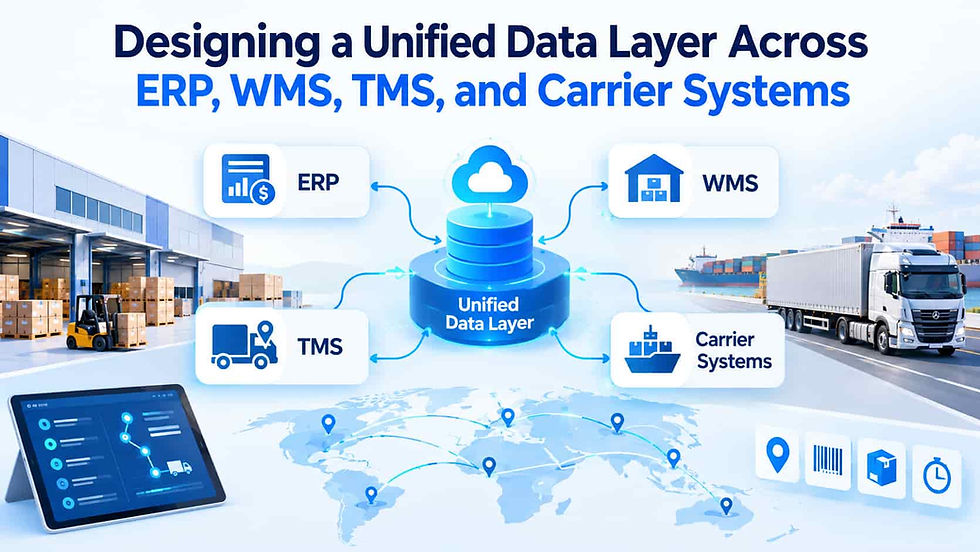
Modern supply chains depend on a network of specialized systems. Enterprise resource planning platforms manage orders, finance, procurement, and master data. Warehouse management systems coordinate inventory and fulfillment. Transportation management systems plan shipments and routes, while carrier platforms provide transportation status and delivery information.
Each system has a specific role, but supply chain operations rarely stay within the boundaries of a single application. An order created in an ERP may trigger warehouse activities, generate a transportation request, and eventually produce tracking events from one or more carriers. When these systems cannot exchange information consistently, organizations face duplicated data, delayed updates, and limited operational visibility.
A unified data layer can address this problem by providing a consistent way to collect, transform, connect, and distribute information across the supply chain.
Why Supply Chain Systems Become Disconnected
ERP, WMS, TMS, and carrier systems are often introduced at different times and for different business requirements. They may use different technologies, data structures, identifiers, and integration methods.
For example, an ERP may identify a customer order with one identifier, while a WMS creates separate identifiers for warehouse tasks, packages, or handling units. A TMS may assign a shipment number, and the carrier may use a tracking number that is not directly connected to the original order.
The information exists, but the relationships between records can be difficult to maintain.
This becomes especially problematic when organizations operate several warehouses, transportation providers, or regional ERP instances. Instead of one consistent flow of information, teams may have to reconcile data between multiple applications.
A unified data layer does not necessarily replace these systems. Instead, it creates an integration and information layer between them.
What a Unified Data Layer Actually Does
A unified data layer provides a common mechanism for handling supply chain information without forcing every operational system to use the same technology.
At its core, the layer can perform several functions:
Collect data from different applications and external systems
Normalize inconsistent data formats
Connect related records across systems
Maintain common business identifiers
Validate incoming information
Enrich records with additional context
Publish data to authorized applications and users
Support event-driven and real-time integrations
For instance, a shipment record might combine information from an ERP order, warehouse fulfillment data, a TMS transportation plan, and carrier tracking events.
The unified layer can establish the relationships between these records so downstream applications do not have to build separate integrations with every other system.
Establishing a Common Data Model
One of the most important design decisions is the data model.
A supply chain organization should define common concepts such as orders, shipments, deliveries, inventory items, locations, carriers, vehicles, packages, handling units, and transportation events.
The model should also define how these entities relate to one another.
An order may contain multiple order lines. Those lines may be allocated to different warehouses. A warehouse can create several packages, which may be grouped into a shipment. That shipment can be assigned to a carrier and generate multiple tracking events.
Without a consistent model, integrations often pass isolated fields rather than meaningful business relationships.
The goal is not necessarily to eliminate every difference between systems. Instead, the data layer should translate local representations into a common structure while preserving information that is important to the originating system.
Connecting Different Identifiers
Identifiers are a major source of integration complexity.
A single business transaction may have an ERP order number, WMS fulfillment identifier, TMS shipment identifier, carrier tracking number, and customer-facing reference.
A unified data layer should maintain relationships between these identifiers. This can be implemented through an identity or cross-reference mechanism that records how identifiers from different systems correspond to the same business entity.
This approach allows users and applications to trace a transaction across the entire process.
For example, a customer service employee could start with an order number and identify the related warehouse fulfillment, shipment, carrier reference, and latest transportation event without manually searching several applications.
Using Events Instead of Only Data Synchronization
Traditional integrations often rely on scheduled synchronization. A system exports information at predefined intervals, and another system imports it later.
This approach can be sufficient for some processes, but transportation and fulfillment often require faster updates.
An event-driven architecture can allow systems to publish events when something meaningful happens. Examples include order created, inventory allocated, shipment dispatched, pickup completed, delivery delayed, or shipment delivered.
The unified data layer can receive these events, normalize them, associate them with the appropriate business entities, and distribute them to relevant consumers.
This makes it easier to make shipment events visible across system boundaries without requiring every application to directly integrate with every carrier or operational platform.
Designing Reliable Integration Flows
A unified data layer must also account for the reality that integrations fail.
External APIs can become unavailable. Messages can arrive more than once. Systems can process events at different speeds. A carrier may provide incomplete information, while an internal application may temporarily be offline.
For this reason, integration architecture should include mechanisms such as message queues, retries, dead-letter handling, idempotency, validation, and monitoring.
Idempotency is particularly important for event processing. If the same carrier event is delivered twice, the system should recognize the duplicate rather than creating two identical business events.
Observability is equally important. Integration teams should be able to determine whether a message was received, transformed, processed, rejected, or delivered to its destination.
Choosing APIs, Events, and Batch Processing
Not every integration needs the same communication pattern.
APIs are useful when one system needs to request or submit information immediately. Events are appropriate when a system needs to notify other applications that something has happened. Batch processing can remain useful for large data volumes, historical transfers, reporting, and processes where immediate updates are unnecessary.
A practical architecture often combines all three.
For example, an ERP might use an API to submit a new order, the WMS might publish an event when the order is packed, and a carrier integration might send tracking updates asynchronously.
The unified data layer coordinates these different patterns without forcing all participating systems into a single integration model.
Data Quality and Governance
Technology alone cannot solve inconsistent supply chain data.
Organizations need clear ownership for important data entities and rules for validation. Questions such as who owns customer information, which system is authoritative for inventory, and how shipment status is calculated should be explicitly defined.
Data quality rules can detect missing addresses, invalid product identifiers, duplicate shipments, unsupported carrier codes, or inconsistent units of measurement.
Governance should also cover access control and data security. Not every application or user needs access to every piece of supply chain information.
A well-designed data layer therefore combines integration capabilities with policies governing how information is created, changed, accessed, and retained.
Supporting Scalability
The architecture should be able to accommodate new systems without requiring a complete redesign.
A company may add another warehouse, onboard a new carrier, introduce a marketplace, replace its TMS, or expand into a new region. If every system has direct point-to-point integrations, each change can create additional development work.
A shared integration layer can reduce this complexity by providing standardized interfaces and reusable transformation logic.
When a new carrier is added, for example, the carrier-specific integration can translate its tracking messages into the organization's common event model. Other applications can consume the normalized events without needing to understand the carrier's proprietary format.
Measuring the Business Impact
The success of a unified data layer should be measured through operational improvements rather than the number of integrations completed.
Relevant metrics may include order-to-shipment processing time, inventory synchronization accuracy, shipment visibility, integration failure rates, manual reconciliation effort, and time required to onboard new partners.
Organizations should also examine how quickly teams can identify and respond to operational exceptions.
The broader objective is to create a connected foundation for supply chain operations where information can move reliably between systems and become available to the people and applications that need it.
Conclusion
ERP, WMS, TMS, and carrier platforms each provide valuable capabilities, but supply chain performance depends on how effectively these systems work together. A unified data layer can connect their information without requiring organizations to replace their existing technology landscape.
The key components include a common data model, cross-system identifiers, event-driven integration, reliable message processing, strong data governance, and scalable interfaces. Together, these capabilities can reduce fragmented information and make operational processes easier to monitor and coordinate.
The most effective architecture is not simply a technical integration hub. It is a shared information foundation that connects business events, systems, and processes across the supply chain while allowing each specialized application to continue performing its intended role.
Comments