


Inside a Hosting Platform: How the Control Plane Works
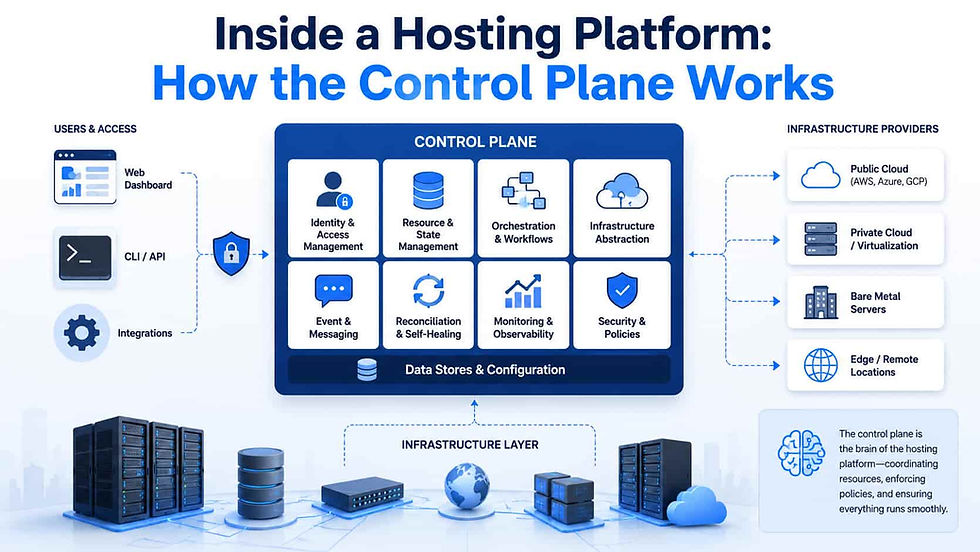
Modern hosting platforms can look deceptively simple from the outside. A customer selects a server, deploys an application, connects a domain, and monitors the result through a web dashboard. Behind that straightforward experience, however, sits a complex control plane responsible for coordinating infrastructure, enforcing policies, automating deployments, and keeping thousands of resources in a consistent state.
Understanding how the control plane works is essential for anyone designing or operating a modern hosting platform. It explains how user requests become infrastructure changes, how automation is coordinated, and why reliability depends on much more than individual servers.
What Is a Hosting Control Plane?
A control plane is the management layer of a hosting platform. It does not necessarily run customer applications itself. Instead, it tells the underlying infrastructure what should exist and how it should behave.
For example, when a customer creates a new virtual machine, the control plane may perform several operations:
Authenticate and authorize the customer.
Validate the requested configuration.
Check available resources.
Select an appropriate infrastructure provider or cluster.
Allocate networking and storage.
Create the virtual machine.
Configure security rules.
Register DNS or other service records.
Update the customer-facing dashboard.
Start monitoring the new resource.
The control plane acts as the coordination mechanism connecting the user interface, databases, orchestration systems, infrastructure providers, and operational tools.
This architecture is particularly important when a platform manages multiple data centers, cloud providers, virtualization clusters, container environments, or dedicated servers.
The Main Components of a Hosting Control Plane
Although implementations differ, most hosting platforms contain several recurring components.
API Gateway
The API is the primary entry point for control-plane operations. Web dashboards, mobile applications, command-line tools, and external integrations communicate with the platform through APIs.
An API request might look conceptually simple: create a server with a particular CPU, memory, operating system, and region.
The API layer must authenticate the request, validate parameters, apply rate limits, and forward the operation to the appropriate backend service.
For larger platforms, an API gateway can also handle request routing, versioning, logging, and centralized security policies.
Identity and Access Management
Hosting platforms manage valuable infrastructure, so permissions must be carefully controlled.
An identity and access management layer determines who can perform particular actions. A customer might be allowed to create and restart their own virtual machines but have no access to another customer's resources.
Role-based access control is common for organizations. Different users may have administrator, developer, billing, or read-only permissions.
Authentication can also integrate with single sign-on, multi-factor authentication, OAuth, or enterprise identity providers.
Resource and State Management
One of the most important responsibilities of the control plane is maintaining a reliable representation of infrastructure state.
The platform needs to know what resources should exist and what their current status is.
For example, a database might record that a customer's virtual machine should have:
Four virtual CPUs
16 GB of RAM
200 GB of storage
A specific operating system
A particular network
A defined security policy
The actual infrastructure may temporarily differ from this desired configuration because a deployment is still running, a node has failed, or an external provider has returned an error.
The control plane continuously works to reconcile these differences.
This desired-state approach is a foundation of many modern infrastructure platforms.
Orchestration: Turning Requests Into Infrastructure
The orchestration layer translates high-level customer actions into concrete infrastructure operations.
Suppose a user clicks "Deploy" in a hosting dashboard. The platform may need to provision a virtual machine, attach storage, configure networking, install an operating system image, create firewall rules, and register monitoring.
Trying to execute everything as one synchronous API request would be fragile. Instead, modern platforms often use asynchronous workflows.
The control plane places tasks into queues or workflow systems. Workers then execute individual operations and report their results.
This provides several advantages. Long-running operations do not block the main API. Failed tasks can be retried. Independent operations can run in parallel, and the platform can track progress.
Workflow engines can also handle more complicated scenarios, such as rolling deployments, automated recovery, and multi-step infrastructure changes.
Infrastructure Abstraction
A hosting business may use different technologies underneath its platform. One environment could rely on VMware, another on KVM, and another on a public cloud provider.
Customers should not necessarily need to understand those differences.
The control plane provides an abstraction layer between the customer-facing API and infrastructure providers. A standardized internal model can represent concepts such as servers, networks, volumes, snapshots, and IP addresses.
Provider-specific adapters then translate those internal operations into the APIs or commands required by each infrastructure system.
This abstraction is one of the most important architectural decisions in hosting infrastructure management because it allows a platform to evolve its underlying infrastructure without completely redesigning its customer experience.
The Role of Databases and Event Systems
A control plane typically depends on several types of data storage.
A relational database may store customers, subscriptions, resource definitions, permissions, and configuration. Other systems can store logs, metrics, events, or temporary workflow state.
Event-driven architecture can make the platform more responsive and scalable.
For instance, creating a server might generate events such as:
"Provisioning requested," "Storage attached," "Network configured," "Operating system installed," and "Deployment completed."
Other services can consume these events independently. Monitoring can update status information, billing can record usage, and notifications can inform the customer.
This reduces direct dependencies between components and makes large platforms easier to extend.
Reconciliation and Self-Healing
One of the most powerful concepts in a control plane is reconciliation.
Instead of assuming that infrastructure will always behave correctly, the system repeatedly compares desired state with observed state.
If a service should be running but is not, the control plane can initiate recovery. If a required configuration has disappeared, the platform can restore it. If a resource was modified outside the platform, reconciliation can detect the difference and apply the intended configuration when appropriate.
This approach helps hosting platforms move from manual administration toward automation and self-healing infrastructure.
However, reconciliation must be carefully designed. Aggressive automation can make problems worse if the platform repeatedly applies incorrect configurations or fights legitimate external changes.
Observability and Reliability
The control plane itself becomes critical infrastructure. If it fails, customers may still have running applications, but they may be unable to deploy, resize, restart, configure, or monitor their resources.
For this reason, control-plane systems require strong observability.
Important signals include API latency, request failures, queue depth, workflow duration, reconciliation errors, infrastructure-provider failures, and database performance.
Distributed tracing can help engineers understand how a single customer action moves through multiple services.
High availability is equally important. Critical components should have redundancy, reliable backups, automated failover, and carefully tested recovery procedures.
Security Considerations
Because the control plane has authority over infrastructure, it is a high-value security target.
Security should be implemented at multiple layers. API requests require strong authentication and authorization. Service-to-service communication should be protected. Secrets should be stored securely rather than embedded in configuration files. Administrative actions should be logged for auditing.
The principle of least privilege is especially important. A service responsible for monitoring should not automatically have permission to destroy customer infrastructure.
Isolation between tenants must also be enforced throughout the architecture, including databases, networks, storage, APIs, and background jobs.
Scaling the Control Plane
As a hosting platform grows, the control plane must handle increasing numbers of customers, resources, events, and infrastructure operations.
Horizontal scaling is often preferable to simply increasing the capacity of individual servers. Stateless API services can be replicated, while queues distribute workloads among workers.
Caching can reduce unnecessary database traffic, and partitioning can prevent very large datasets from becoming bottlenecks.
Importantly, infrastructure operations should remain asynchronous whenever they can take significant time. This prevents a slow provider API or large deployment from affecting unrelated customer requests.
Conclusion
The control plane is the operational brain of a hosting platform. It connects customer interfaces with infrastructure while managing authentication, resource state, orchestration, networking, storage, monitoring, and automated recovery.
A well-designed control plane does more than execute commands. It maintains a desired state, coordinates distributed operations, handles failures, and provides a consistent experience even when the infrastructure underneath is complex and constantly changing.
For hosting companies planning to scale, investing in a robust control plane is therefore not simply an architectural choice. It is a foundation for automation, reliability, security, and sustainable infrastructure growth.
Comments